Monday, March 4, 2013

Stalag Luft III: The Great Scape

Stalag Luft III was a prisoner of war camp built in 1942 and it was directly controlled by the High Command of the Luftwaffe. It was part of the network of Zagan camps. It was the last one established in the adjacent area to Stalag VIIIC, in the East. At first, most of the prisoners were from the British Royal Air Force and American pilots but they were gradually arriving pilots of various nationalities. They became a total of 10,494 prisoners.

 Prisoners in a small plantation in front of the barracks.

Stalag Luft III was famous for the escape attempts. The biggest one was organized by a secret committee "X" established by the prisoners in the spring of 1943 and led by the Commander Roger Bushell. They built three tunnels, "Tom", "Dick" and "Harry". Tom was going to be the main escape tunnel, Harry and Dick the plan B in case the Germans were able to learn their plans. Tom was discovered 5 months later so they had to escape through Harry. The flight took place the night of March 24, 1944. Eighty prisoners managed to escape from the camp through the 111 meters tunnel. When it was discovered what was happening and the alarm was raised, four prisoners were caught inside the tunnel. They began an exhaustive search throughout the country and managed to hunt down another 73. Only three of the prisoners managed to escape and return to their countries. In retaliation, under direct orders of Hitler, 50 of the escapees were shot.

tunnel harry

In 1963, this story was filmed by John Sturges with Steve McQueen, James Garner and Richard Attenborough, among others. If this movie fascinates you as much as me and you want to visit what remains of the Stalag here are some tips for your trip.


GETTING TO STALAG LUFT III

The Stalag Luft III is in Zagan , a small town in southwestern Poland, where there are no tourists and no one speaks a word of English. It's convenient that you bring a map printed, the accommodation booked if you want to stay overnight and the transport cheked before you go. If we go through the day it is best to hire a car from any major city. It is very close to Germany, from cities such as Dresden or Berlin it can be reached in less than two hours. It also has a train station and a bus that communicates with some cities both Poland and Germany, but in general will have to make more than one transfer to reach. Websites of the public transports:

From Wroclaw, 165km away, is easy to get Zagan by public transport. We can return the same day by train or bus:
  • By train   we can catch a train from the main station in Wroclaw ( Wroclaw Glówny ) to Zagan station . There are direct trains that reach Zagan in 2h 20min. If you want to return the same day you will have to check here for the trains schedule.
  • By bus: there are buses from the company PKS (Żary direction) from the main bus station in Wroclaw to Zagan station (some of them has a first stop in Piłsudskiego Street). They depart at 07:40 and arrive at the Zagan station at 11:05. The ticket price is of 36.50 zlotys (about 9 euros) round. If you want to return the same day by bus, in the same station there is one bus at 17:20 that leaves you back in Wroclaw at 20:15. You can check here the route and schedule. These services may not travel every day of the week. You'll have to check in advance. Bus schedule:

Thursday, February 28, 2013

Orador-sur-Glane (France), the ghost town

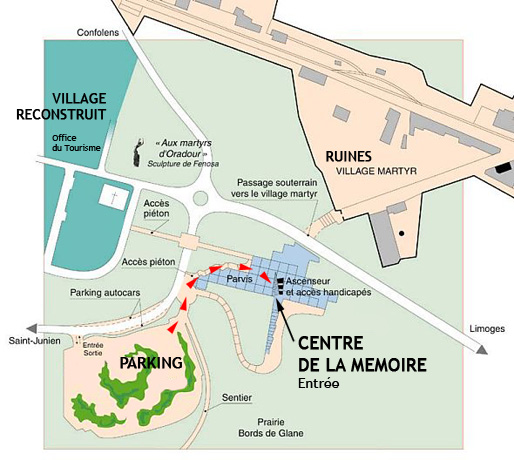
After the Allied landings in France on June 6, 1944, the French partisans began a series of actions such as the kidnapping of the SS Colonel Helmut Kampfe. The commander Diekman was sent to Oradour by false information which indicated that the colonel was held in the village. Feeling frustrated by being cheated, he ordered the murder of all the inhabitants of Oradour. 642 people died. All men were called and were taken taken to shelters where they were shot and burned. They also locked all the women and children in the church and set fire. Only six people survived the slaughter. The whole village disappeared. He reconstructed the town around the original but keeping intact the scene of the massacre, as a memorial and reminder of the horrors of war. Today, we can visit this ghost village and walk the streets as they were left after the June 10, 1944. This area is called the Village Martyr .


GETTING TO ORADOUR
  • By car: click here to see the location. Roads in France are pretty good so it's the easiest way to arrive there.
  • By train: from many cities you can take the TGV train to Limoges. From Limoges there are buses that leave leave you in half an hour to the Oradour's center of memory. You can check here the bus schedule.
  • By air: Limoges has an airport. There are flights from Paris (Orly) with TwinJet (1h10min) or with Ryanair from London or Liverpool (1h40min) for low cost. Another option is to take a plane to Bordeaux . Once in Bordeaux there are direct trains to Limoges for about 30 euros ( 2h 30min ). You can check schedules and prices here . From Limoges to Oradour by bus (30min).

ACOMMODATION IN ORADOUR

 If you want to spend the night in Oradour itself there is not much choice. You have the Glane Hotel  beside the Village Martyr and the b&b Le Moulin de la Fauvette 2km. If you prefer to stay in Limoges there is a lot more variety . Also if you stay here you can go to the Resistance Museum .


THE CENTER OF THE MEMORY ORADOUR

 Photo: Babsy

Location : here .  
Official website: http://www.oradour.org  
Openning hours: (last admission one hour before closing)
From 1 February to 28 February: 9:00-17:00
From 1 March to 15 May : 9:00-18:00
From 16 May to 15 September: 9:00-19:00
From 16 September to 31 October: 9:00-18:00
From 1 November to 15 December: 9:00-17:00
16 December to 31 January closed. 
Admission: 7.80 euros


It opened in 1999. It is the main access to the Village Martyr. This is a museum created to commemorate both the history of Oradour as the German invasion of France. The permanent exhibition "Understanding Oradour" includes a campus tour through the years 1933-1944, the days June 9th and 10th 1944, the reconstruction of the town and a universal message.


THE VILLAGE MARTYR

The Village Martyr is the area which includes the ruins of the village. You enter through the Centre of the Memory but you can access the ruins without making the tour of the museum. The admission is free.

 Photos: JLPC

After the ruins, we find the cemetery where they buried the victims of the slaughter. You can also visit a memorial located in an underground crypt with objects found in the ruins of the buildings. It is located at the entrance of the cemetery.


Source: http://www.oradour-souviens-toi.fr

Fort Eben-Emael & Fort Breendonk, Belgium

If you travel to Belgium there are two interenting stops that you can make. Belgium is a small country and the distance between one place and another allows to make round trips in the same day.


View larger map


FORT EBEN-EMAEL

Location here. It is located 115 km away from Brussels.  
Official website: http://www.fort-eben-emael.be
For individual visitors only open one weekend a month . Dates vary each year. You can click here to see what they are.
Open to visitor groups all year except holidays listed on the web . If you go in a group will have to book by filling this form at least 15 days before your arrival. You can choose the language of the visit between English, French, German and Dutch. The duration of the visit is from 1 hour (5 euros per person, minimum 60 euros per group) to 6 hours (12 euros per person, minimum 180 euros per group).  

How get to fort Eben-Emael from Brussels? You can rent a car in Brussels and take the E10 (see full itinerary ). To arrive by public transport the best option is to take a train from Brussels Central Station to  Tongeren (for times http://www.belgianrail.be/en/Default.aspx ). The journey takes 1hr 50min. Once in Tongeren you have to take in front of the station the bus 39 that will leave you at the fort in 30 min.


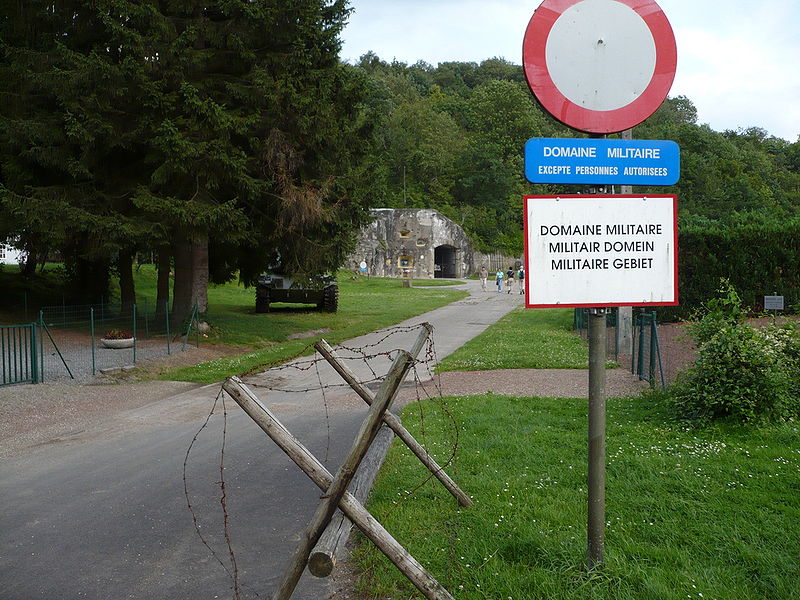
Eben-Emael was a fortress built as a defense against a possible German invasion. It was completed in 1935 and its structure of steel and concrete made ​​the Allies think that it was impenetrable. They thought they would be able to stop the German invasion long time. The German army carefully studied its structure and they even built a replica for assault practices. Finally, in 1940, 85 Fallschirmjäger landed on the roof of the fort by gliders. After a strong assault managed to retain the Belgians until the arrival of a German infantry division, they had to surrender. Today, the fort is still military property although the Association of Fort Eben-Emael allows the tours.
The main weapons were distributed between turrets and casemates. It is divided into: Blocks I, II, III, IV and V, Dome 120, North and South Domes, Visé I and II, Maastricht I and II, North and South Canal, Mi-North and South Block O1.

Entry . Foto: Hbar.cc

Maastricht II . Foto: Scargill
Interior hallway.

Dome 120.

FORT BREENDONK

Location here . It is 25 km away from Brussels.
Open every day except January 1, 24 and 25 December and the annual pilgrimage.
Official website: http://www.breendonk.be  
Opening hours: 9:30 to 17:30 (last admission 16:30)  
Admission: 7 euros
The duration of the visit is estimated a minimum of 2 hours. There are audio guides in English, Dutch, French and German.


Wednesday, February 27, 2013

Visiting Auschwitz Birkenau

Auschwitz concentration camp was the largest Nazi death camp. It's estimated that about 2 million people (Jews, mostly) perished in it. It was declared World Heritage Site in 1979. It was directed, under Himler's supervision, by Rudolf Hoss until 1943 when it was replaced by Arthur Liebehenschel and Richard Baer .
 
It housed some famous prisioners as the prestigious psychiatrist Viktor Frankl , who survived and wrote his memoirs in the camp in " Man's Search for Meaning "or the beatified St. Maximilian Kolbe , who died after voluntarily changing the position of a condemned man.


The complex is divided into three camps: Auschwitz I, Auschwitz II (Birkenau) and Auschwitz III. Today you can only see the I and II..


HOW TO GET AUSCHWITZ FROM KRAKOW

The best way to get to the camp is to catch a bus at the main bus station in Krakow (location here ). It runs every half hour and the ticket is purchased directly on the bus. The ticket price is 20 zlotys outward / return ($7). The bus direction is Oswiecim (signposted both the bus and on the platform where parking). It takes half an hour to arrive and it leaves us in the parking of Auschwitz I, next to the entrance. If you go by train to Auschwitz, you will have to walk 1.2 miles to the entrance of Auschwitz I.


AUSCHWITZ I

Location here .
Official Website: http://www.auschwitz.org
Open every day except 1 January, 25 December and Easter Sunday.
Opening hours:
  • 8:00 a.m. to 3:00 PM from December to February
  • 8:00 a.m. to 4:00 PM March, November
  • 8:00 a.m. to 5:00 PM April, October
  • 8:00 a.m. to 6:00 PM May, September
  • 8:00 a.m. to 7:00 PM June, July, August

From November 1 to March 31 admission is free, but guided tours are 40 zlotys ($13).  
Guided tours schedule:
• Polish: 11.00 am, 1.30 pm (except 27/01/2013)
• English: 10.30 am, 11.30 am, 12.30 pm, 1.20 pm (except 01/27/2013)
• French: 12.30 pm (except 13.11.2012, 14.11.2012 and 01.27.2013)
• German: 12.30 pm (except 01/27/2013)
• Italian: 24:30 (except 14.01, 23.01, 27.01, 09.03, 17.03 and 03.18.2013)
• Spanish: 12.30 pm (except 27/01/2013)
From April to October is mandatory ent with tour, 40 zlotys ($13).  
Guided tours schedule:
• Spanish: April, October: 12.00 am from May to September: 10.00 am, 12.00 am, 2 pm
• English: October: every hour between 10.30 am and 3.30 pm from May to September: every 30 minutes between 9.30 am - 3.30 pm
It is estimated that the tour lasts about 4 hours.


It's better to visit the camp during the fall-winter months. In the summer months there are many visitors and the visit is more uncomfortable. Moreover, in summer months it's required to enter with a guided tour and it's not the best way to see it. I would recommend to spend a full day to visit the camp on your own, without a guide. You can cross the entrance with the guided group and once inside go by yourself.


If you want to plan your visit, the official website offers a virtual tour where you can find what is in each barrack. You can click here go there.